
XPENG WorldGPT Unveiled as Shared Physical AI Foundation
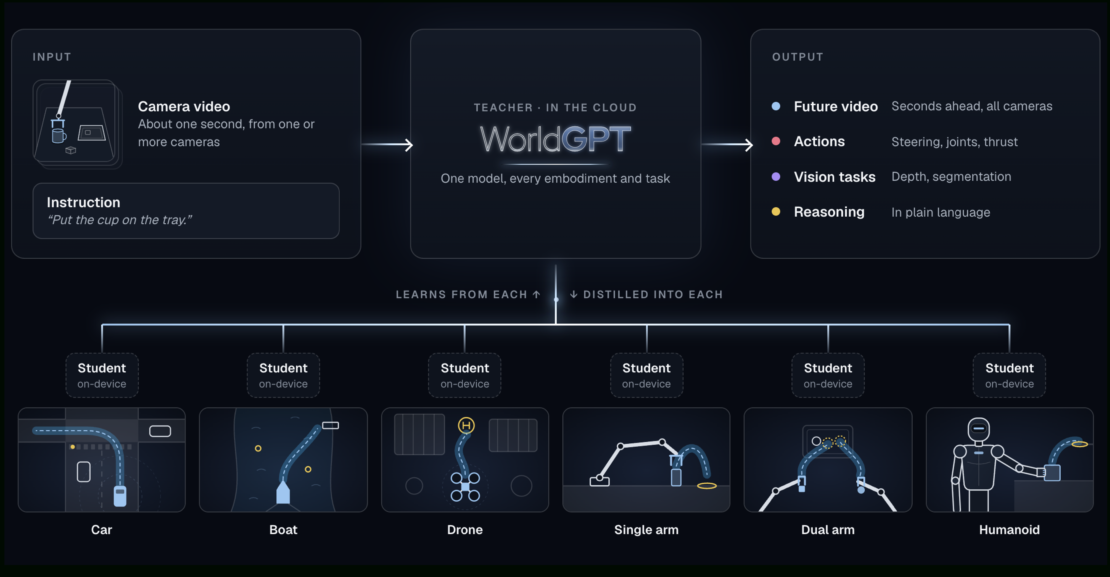
XPENG has announced the launch of WorldGPT, an artificial intelligence model engineered to unify learning across six distinct machine types: cars, boats, drones, single-arm robots, dual-arm robots, and humanoid robots. Part of the XPENG Turing World Model family, the system is designed to provide a shared understanding of physical environments, enabling machines to predict future scenarios, plan actions, and reason using natural language based on camera inputs.
Cloud Teacher Architecture and Efficiency
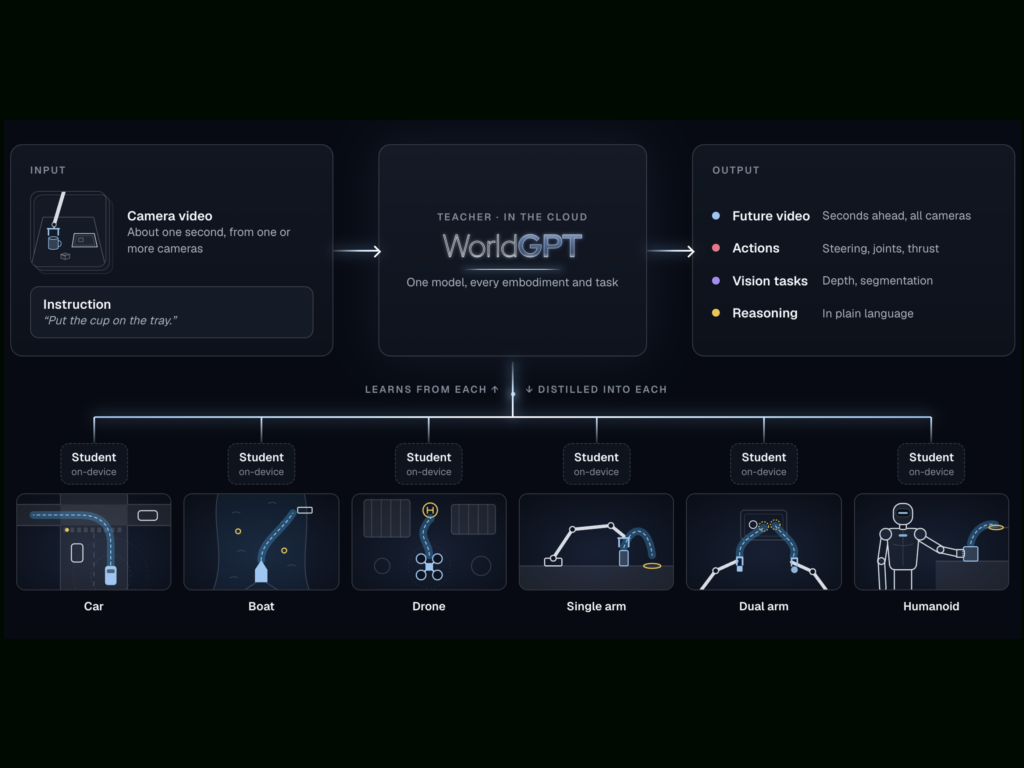
Unlike traditional machine-specific AI development that requires building dedicated models from scratch, WorldGPT functions as a large cloud-based “teacher model.” It aggregates visual data and shared physical principles across multiple platforms, distilling this knowledge into smaller, specialized on-device models. This architecture aims to reduce engineering overhead and streamline the expansion of physical AI capabilities into new hardware formats.
Benchmark Results and Autonomous Performance
As of November 12, 2026, XPENG reported that WorldGPT achieved twelve first-place rankings across public industry benchmarks spanning autonomous driving, robotic manipulation, visual understanding, and video generation. Specific highlights include leading results in standard and challenging driving evaluations on NAVSIM v2, a 95.2% average success rate across 50 single-arm manipulation tasks, and top scores on CV-Bench and VBench 2.0.
Relevance for European EV Buyers
For European buyers following advancements in intelligent mobility and autonomous driving software, XPENG’s underlying foundation models directly influence the future evolution of driver assistance and smart vehicle architectures deployed across global markets.
Practical Takeaway
XPENG WorldGPT represents an infrastructural leap toward cross-domain physical AI, utilizing a cloud-teacher framework to improve software efficiency and autonomous capabilities across intelligent vehicles and robotics.
Source: Original report