
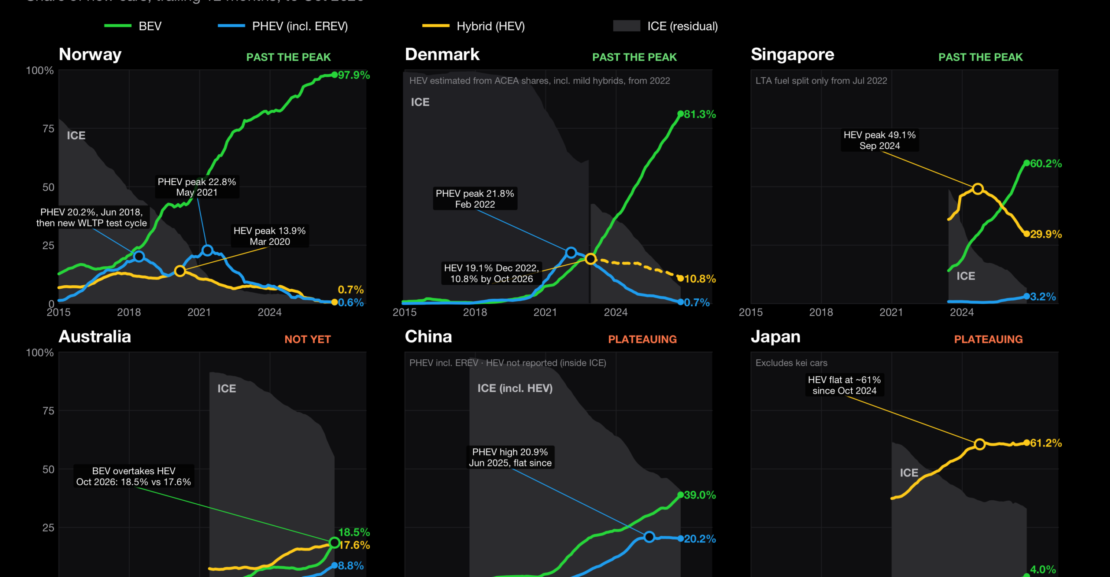
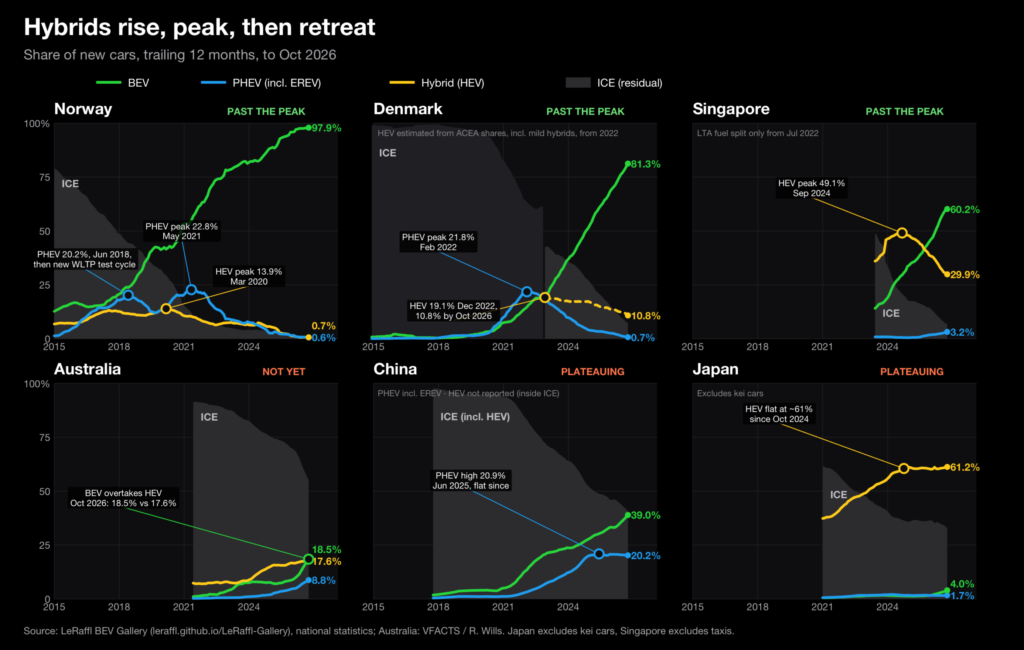
Recent vehicle registration data from mature electrification markets indicates that hybrid and plug-in hybrid vehicles are functioning as a temporary transition phase rather than a permanent fixture of the future car market. Analysis of long-term adoption trends shows that once battery-electric vehicles offer sufficient choice, charging confidence, and competitive economics, hybrid market shares tend to peak and subsequently retreat.
Registration Trends in Mature Markets
Data from Norway illustrates the trajectory of vehicle adoption over an extended period. By October 2026, battery-electric vehicles accounted for 98.8% of new passenger-car registrations in the country. Petrol plug-in hybrids represented 0.2%, and petrol full hybrids accounted for 0.3%. Across the first ten months of the year, battery-electric vehicles held 98% of the market.
Similar patterns emerge in other regulated environments. In Singapore, conventional hybrids accounted for 28.3% of new registrations in October 2026, while battery-electric vehicles captured 59.6% and plug-in hybrids reached 6.2%, reflecting shifting dynamics as electric options expand. In Denmark, battery-electric vehicles accounted for 88.2% of all new passenger-car registrations and 97.4% of household new car purchases in October 2026. Across the European Union during the first ten months of 2026, battery-electric vehicles represented 23.4% of new-car registrations while hybrids maintained a larger share, demonstrating that markets are progressing at different paces along a similar directional path.
Real-World Performance of Plug-In Hybrids
Plug-in hybrid vehicles present distinct operational challenges regarding real-world emissions and fuel usage. Data cited from the European Commission covering 320,000 plug-in hybrids registered in 2021 revealed that real-world carbon dioxide emissions averaged 3.5 times their official type-approval values. The findings indicate that many of these vehicles are not being charged and driven electrically as frequently as assumed in laboratory testing, particularly within company vehicle fleets where employer-paid fuel incentives often default usage to the internal combustion engine.
Implications for European Buyers
For European buyers and fleet operators, these registration trends carry practical financial implications regarding asset depreciation. Purchasing a traditional hybrid or plug-in hybrid in a market that has not yet reached its electrification tipping point introduces potential residual-value risk. If new-car demand shifts rapidly toward battery-electric alternatives while used-car inventories remain heavily weighted toward hybrids, resale values may face downward pressure.
Practical Takeaway
Buyers and fleet managers should carefully evaluate local charging infrastructure, real-world driving profiles, and changing market adoption rates before purchasing a transitional hybrid. Considering the accelerating shift toward battery-electric vehicles in mature regions can help mitigate future residual-value risks on the used market.
Source: Original report