

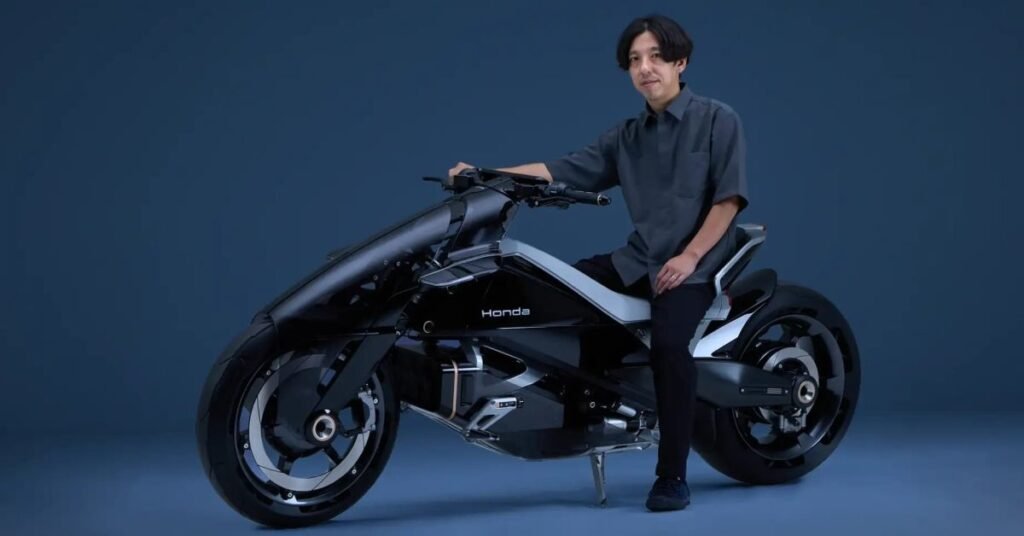
Honda has introduced the EV Outlier Concept, an unconventional electric motorcycle designed to explore future styling and engineering possibilities beyond the year 2030. Initially unveiled at the Japan Mobility Show and recently showcased in person at the EICMA exhibition in Milan, the concept breaks away from conventional motorcycle architecture by avoiding a simple engine-to-battery swap.
All-Wheel Drive and In-Wheel Motor Layout
The layout of the EV Outlier Concept utilizes motors housed directly inside both wheels rather than employing a centrally mounted motor driving the rear wheel. This configuration provides all-wheel drive capabilities and allows designers to alter the core structure of the machine. The battery pack is housed within a large central body structure, while the rider sits lower and further back than on traditional motorcycles.
Design Philosophy and Rider Ergonomics
Honda summarizes the design approach of the concept using three core descriptors: gliding, ecstasy, and low. Gliding represents the smooth and quiet operation of electric propulsion, while ecstasy denotes the instant acceleration and torque delivered by independently controlled front and rear motors. The low descriptor refers to the intentionally dropped seating and eye position, which establishes a distinct riding sensation compared to standard internal combustion motorcycles.
To support the rider during hard acceleration, the machine features a bucket-style backrest that allows the rider to pivot through corners around their hips. Traditional mirrors have been omitted in favor of camera systems. Additionally, a wide digital cockpit displays telemetry data including lean angles, selectable riding modes, front motor torque adjustments, and real-time operational metrics for both wheels.
Practical Takeaway
While the Honda EV Outlier Concept serves primarily as a design study and a statement of intent for future mobility rather than a confirmed production model, it highlights how manufacturers are reimagining motorcycle architecture to leverage the design freedom offered by electric powertrains.
Source: Original report