
GMI Group Hydrogen Bulk Carrier Program
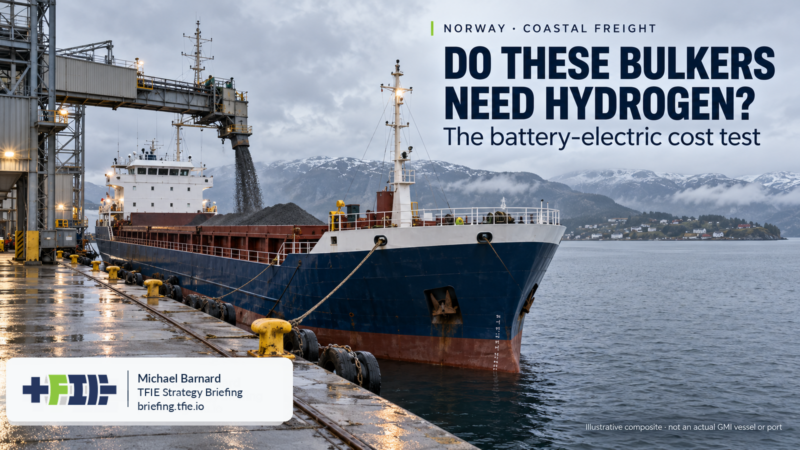
Norwegian shipping company GMI Group is moving ahead with four hydrogen-electric bulk carriers designated for coastal freight operations. In October 2026, PowerCell confirmed a follow-up order that brings the program total to 24 marine fuel-cell units, delivering a combined installed capacity of 5.4 MW. The first two vessels are planned for 2027 and are rated at 4,000 deadweight tonnes, while two additional 3,000-tonne vessels are expected to follow in 2029. The shipbuilding initiative has received substantial public support, including Enova awards totaling roughly €42.9 million reported by Norsk Hydrogenforum for the four vessels, alongside additional public support granted to GreenH hydrogen production projects.
Economic Analysis and Fleet Comparisons
While GMI states that its vessel design can achieve lifetime costs 9–10% below conventional ships by combining fuel cells, batteries, efficient hulls, and wind assistance, independent modeling scenarios present a different economic outlook. Modeled comparisons of 3,000-tonne coastal bulk services covering 80 and 55 nautical miles over a fifteen-year period indicated that hydrogen propulsion can be 50–58% more expensive than conventional diesel, even after assuming approximately €13.1 million in upfront public vessel support. In the modeled 80-nautical-mile scenario, shipowner costs reached €43.68 million for hydrogen after an assumed €13.09 million vessel grant, compared to €29.55 million for battery-electric alternatives. GMI has not published the specific route and commercial data required for a direct assessment of its actual contracts.
Infrastructure and Operational Requirements
Both hydrogen and battery-electric propulsion systems entail distinct infrastructure demands across Norwegian ports. Battery-electric alternatives require adequate grid connections, charging equipment, and sufficient berth time, which may not be readily available at every location. Conversely, hydrogen propulsion involves converting renewable electricity into hydrogen, compressing, storing, delivering it to the vessel, and converting it back via fuel cells. These additional processing steps introduce capital costs and energy losses that cannot be eliminated by efficient hulls and sails alone, raising important economic and logistical considerations for short coastal voyages.
Practical Takeaway
For European maritime stakeholders and logistics planners, evaluating zero-emission coastal freight requires direct comparison of total lifetime costs, grid availability, and public subsidy impacts. Credible battery-electric and hydrogen bids must account for realistic entry-into-service dates, local charging constraints, and transparent route economics before large-scale public and private commitments are finalized.
Source: Original report